Pagine

Showing posts with label 1974. Show all posts

Thursday, 30 October 2014

Majokko Megu-chan (魔女っ子メグちゃんLittle Meg the Witch Girl) - Opening HQ - [1974]


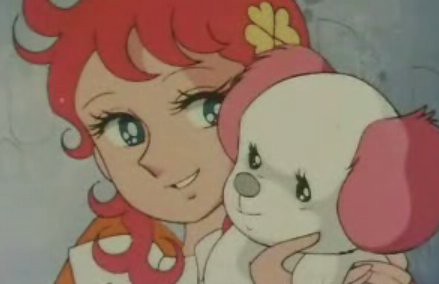
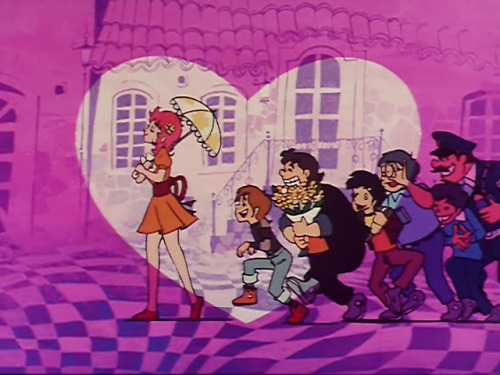
Majokko Megu-chan (魔女っ子メグちゃん, lit. Little Meg the Witch Girl), in Italy "Bia la sfida della magia", is a magical girl anime series. The manga was created by Tomo Inoue and Akio Narita, while the 72-episode anime series was produced by Toei Animation between 1974 and 1975. This series is considered an important forerunner of the present day magical girl genre, as the series' characterization and general structure exerted considerable influence over future shows in the same genre. Most notably, several of the show's recurring motifs were recycled in Toei's Sailor Moon, AIC's Pretty Sammy, and (to a lesser degree) Wedding Peach.[1]

Megu-Chan follows the experiences of a powerful (but accident-prone) young witch who comes to Earth as part of her initiation into larger society. Megu is a contender for the throne of the Witch World but knows very little of human relationships. Sent to Mid-World (Earth) in her early teens, she is adopted by Mammi Kanzaki, a former witch who gave up her royal ambitions to wed a mortal. Mammi bewitches her husband and their two children, Rabi and Apo, into believing that Megu has always been the eldest child of the family (the concept of using magic to alter memory would turn up again in future magical girl series, such as Majokko Tickle andSailor Moon). Under Mammi’s tutelage, Megu learns to control both her abilities and impulses in order to prove her worthiness for the crown.
This rite-of-passage subtext is continued throughout the series. A free spirit in the purest sense of the word, Megu-chan discovers emotions she’d never known existed – loneliness, compassion, grief, love, desperation, and (perhaps most importantly) self-sacrifice. As the story progresses, she proves the nobility of her character through the various trials and tribulations of youth, evolving from a willful and rather selfish little girl into a kind, generous, loving young woman. She battles monsters, demons, and rival sorcerers (including her nemesis, Non), but quickly realizes that her true enemy is the darker side of human nature.


Monday, 27 October 2014

Getter Robot (ゲッターロボ Gettā Robo) - Opening - [1974]

Getter Robo (ゲッターロボ Gettā Robo, typically romanized as Getter Robot in the various manga) is a Super Robot manga series created by Ken Ishikawa, as well as an anime series produced by Toei Animation. The series was broadcast on Fuji TV from April 4, 1974 to May 8, 1975, with a total of 51 episodes. Getter Robo is commonly mistaken for a Go Nagai work. While this isn't necessarily false, Go Nagai's involvement in the series was minimal, as the entirety of the original manga and subsequent manga sequels were both drawn and written by Ken Ishikawa.


The plot involves three strong-willed teenagers: martial artist Ryoma Nagare, homicidal psychopath Hayato Jin and fat Judoka Musashi Tomoe, who pilot three specially designed combat jets (Eagle, Jaguar, and Bear) which can be combined together into three different giant robots, Getter-1 (balanced and for flight combat), Getter-2 (fast and for ground combat), and Getter-3 (strong and for marine combat). They were assembled by Prof. Saotome, who conceived the Getter Robo project as a means of deep-space exploration. The Getter machine is powered by an energy source known as Getter Rays, which are the invisible manifestation of the pilot's willpower. It became instead Earth's first line of defense against the Dinosaur Empire, a civilization of reptile-like humanoids who evolved from the now-extinct dinosaurs that roamed the earth millions of years ago. They have lived many years underground after being forced to do so by getter ray radiation from space that did not affect the apes who evolved into humans; they now want to reclaim the Earth as theirs and destroy humanity.
The series was groundbreaking in the anime mecha genre: for the very first time, it introduced the concept of separate machines combining to form a Super Robot. Using three jets, Getter Robo could combine in three different ways to create three different versions of Getter Robo for different conditions and situations. This idea was originally discussed during the creation process for Mazinger Z (the first Super Robot to be piloted internally), but was dropped and then developed for Getter Robo. This idea of combination and transformation proved to be a very powerful concept that has been used in the super robot genre ever since. Also, by adding three pilots to the robot was able to add an element of teen drama, probably influenced by the already popular anime sci-fi team show Gatchaman (better known in the U.S. as Battle of the Planets, G-Force: Guardians of Space or Eagle Riders).


Monday, 15 September 2014

Chobin, il principe stellare (星の子チョビン Hoshi no ko Chobin) - [Rintaro] - [1974]

Genres: adventure, science fiction

Chobin, il principe stellare (星の子チョビン Hoshi no ko Chobin) è un anime del 1974 diretto da Rintaro prodotto in 26 episodi dallo studio Tatsunoko e trasmesso in Giappone dal network TBS.
Creata dalla fervida fantasia del mangaka Shotaro Ishinomori, la serie riesce a raccontare una avventurosa storia fantascientifica con canoni più simili a quelli della fiaba, un inusuale, ma riuscito connubio che ne decretò il successo anche presso fasce di pubblico (genitori, bambine e ragazze) normalmente non attratte dalla science fiction animata nipponica.

Trama

Chobin è una buffa creatura (in realtà una vera e propria "larva" della sua razza, che allo stadio adulto assumerà la forma di un bellissimo umanoide dotato di ali trasparenti e lineamenti elfici) che precipita sulla terra dopo la conquista del proprio pianeta natale da parte delle tiranniche forze diBrunga, figura demoniaca paludata in un manto oscuro e dotata di ali da pipistrello.
Aiutato da un anziano eremita e dalla sua nipote (oltre che dagli animali della foresta, con cui riesce a comunicare in qualche modo, grazie al talismano denominato "goccia di stella") il piccolo "principe stellare" eviterà dapprima le insidie e i sicari inviatigli contro da Brunga e quindi muoverà al contrattacco riuscendo a sconfiggerlo e a liberare sua madre, caduta sua prigioniera.
La sigla italiana (scritta da F. Migliacci) è incisa da "il mago, la fata e la zucca bacata" su dischi RCA. (da notare che in chiusura era possibile sentire soltanto il ritornello della canzone, forse per non far apparire Brunga in chiusura, magari al termine dell'ultima puntata, in seguito alla sua uccisione) Negli anni in cui questo cartone animato era trasmesso sulle reti Fininvest, la videosigla presentava un patchwork di sequenze prese dalle varie puntate, ma a partire dal 2000, con la ritrasmissione del cartone animato sulle TV locali, sono state scelte delle sequenze più appropriate alle parole della canzone.


Chobin - opening italiana


Chobin - opening giapponese


Hoshi no ko Chobin.jpg

Series Director: Rintaro
Original creator: Shotaro Ishinomori
Character Design: Norio Yazawa
Art Director: Katsumi Hando
Animation Director: Norio Yazawa
Director of Photography: Akio Sakahigashi
Producer:

Fuyumi Shiraishi as Chobin

Eiko Masuyama as Queen Ekurea
Hiroko Maruyama as Kero
Ichirô Nagai as Akabeh
Jouji Yanami as Owl
Kazuya Tatekabe as Radar Bat
Kousei Tomita as Kumandon
Kousei Yagi as Doctor
Mari Okamoto as Ruri
Michiko Hirai as Sagiri
Tamio Ohki as Burunga
Yasuo Yamada as Usatan
Yoshiko Matsuo as Chirochon

Broadcaster: TBS