The Daicon III and IV Opening Animations are two short, anime, 8 mm films that were produced for the 1981 Daicon III and 1983 Daicon IV Nihon SF Taikai conventions. They were produced by a group of amateur animators known as Daicon Film, who would later go on to form the animation studio Gainax. The films are known for their unusually high production values for amateur works and for including numerous references to otaku culture.
Daicon III was made by Hideaki Anno, Hiroyuki Yamaga and Takami Akai and Daicon IV credits twelve people, including Yamada as the director and Anno and Akai as animation supervisors. Despite the questionable legal status of the works, the production of Daicon III resulted in debts that were repaid by selling video tapes and 8mm reels of the production; of which the profits went to the production of Daicon IV. In 2001, the anime magazine Animage ranked the Daicon animations as the 35th of the "Top 100" anime of all time.
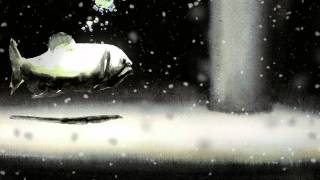
Daicon III Opening Animation
The Jet VTOL ship from
Ultraman's Science Patrol descends out of the sky toward Earth, as a school girl, carrying her
randoseru, observes from behind a tree. They offer the girl a cup of water and ask her to deliver it to "DAICON". The girl salutes and races away, but she quickly experiences trouble as
Punk Dragon blocks her path. He summons a
mecha from
Starship Troopers and it and the girl begin battling. The girl tosses the mecha aside and
Gomora rises from the earth. Using a booster concealed in her backpack, the girl flies up into the sky and evades Gomora's blast, with the mecha flying after her. They continue their battle in mid-air. A blow from the mecha sends the girl falling, imperilling her precious cup of water. At the last moment, she has a vision of the Science Patrol and regains consciousness. She snatches the cup before it crashes to the ground, saving the water. Resuming her battle with the enemy mecha, she catches one of its missiles and hurls it back at the mecha, causing a huge explosion. The destroyed mecha launches a rocket, summoning
Godzilla with the
Ideon symbol. With
King Ghidorah and
Gamera chasing her, the girl flies through the air with her jet-propelled backpack. A
Star Destroyer, a
TIE fighter, and some Martian fighting machines from the 1953
War of the Worlds movie cross the background. Reaching into her backpack the girl whips out a bamboo ruler, which magically becomes a
lightsaber. After slicing an
Alien Baltan in half, the girl launches a number of micro-missiles from her backpack. Hit by one of the missiles, a Maser Tank from
the Godzilla movies catches fire. The
Atragon breaks in two as the
Yamato, the
Enterprise, an
X-Wing, and
Daimajin explode in complete chaos. The girl pours her cup of water on a shriveled
daikon buried in the ground. As the daikon revives, it turns into the spaceship
Daicon. Bathed in light, and now wearing a commander's uniform, the girl boards the ship, where the film's producers,
Toshio Okada and
Yasuhiro Takeda, sit at the controls. As the landing gear retracts,
Daicon departs for the far reaches of the universe.
Daicon IV Opening Animation
The
Daicon IV Opening Animation begins with an abridged, 90-second retelling of the
Daicon III Opening Animation set to music by
Kitarō. After this, the lyrics to "Prologue" by
Electric Light Orchestra appear against a starry background, while an outline of the spaceship
Daicon passes in the background. The music then segues to "
Twilight", the next song on the ELO album
Time and the fast-paced animation begins.
The girl with the backpack from the
Daicon III Opening Animation has now grown up into a
bunny girl. She fights off a multitude of sci-fi monsters
[a] and
mobile suits then jumps into a throng of Metron Seijin and tosses them aside.
[b] She is then in a lightsaber duel with
Darth Vader, with
Stormtrooper sitting Japanese-style in the background and the
Death Starenshrined in one corner. From atop a cliff, a
xenomorph with mecha legs, wielding the
Discovery One, knocks the bunny girl down with a shock wave blast and the
Dynaman robot crushes the girl. The bunny girl lifts the Dynaman robot off her with superhuman strength, smashes it against the cliff, and celebrates in the first example of the Gainax Bounce. The
Stormbringer suddenly appears in the sky and the bunny girl hops on it like a surfer. A few random sequences are shown, such as
Yoda as
Yū Ida given a Japanese comedy routine with various characters in the audience.
[c] The bunny girl is still surfing on the Stormbringer when she runs into a formation of Ultrahawk 1's. Then the
Yamato, the
Arcadia attached to the transformed
SDF-1 Macross appear, along with an exploding
VF-1 Valkyrie variable fighter from
Macross armed with a
Gundam-style beam saber. A mid-air battle unfolds in an
otaku coffee shop. The bunny girl then travels into an extra-dimensional world filled with American comic superheros.
[d] A host of machines and characters (
Lord of the Rings,
Conan,
Narnia, others) fly past her into space, including a
Klingon battlecruiser, the moon ship from
H.G. Wells First Men in the Moon, the
Millennium Falcon and the
Thunderbirds.
[e]Once back on land, the bunny girl jumps off the Stormbringer and it splits into seven parts, which fly though the sky spewing smoke in seven colors. A random sequence of famous spaceships crashing into each other is shown. Then suddenly, "what could only be described as an atomic bomb"
[1] hits an unpopulated city. After the blast, there is a flurry of
sakurapetals. Successive upheavals of the Earth give birth to new worlds. As a beam launched by the
Daicon traverses the sky, lush greenery sprouts and grows. The camera then pans over a massive crowd of fictional characters,
[f] the sun rises, the camera zooms out to the solar system, and the film ends.
Production
Originally the productions were intended to be shot in 16 mm film, but both were shot in 8 mm film instead and were completed only the morning before their debut.
[2] In order to pay off the debts of the productions, video copies of the animation were sold. Eng declares this as the first example of
original video animation (OVA) predating
Dallos.
[2] Kazutaka Miyatake of
Studio Nue originally designed the mecha that appears in the
Daicon III clip chasing the little girl for a Japanese edition of the
Starship Troopers Military sci-fi novel in the early eighties.
[3]
Daicon III
Only three people were involved in the production of
Daicon III,
Hideaki Anno,
Hiroyuki Yamaga and
Takami Akai.
[4] Takeda, who was a part of the group, explains in
Notenki Memoirs that Anno knew how to make anime, but he never worked with animation cels. They were referred to Animepolis Pero, an anime hobby store chain, but they found that the cost of the cels were too expensive, so a single cel was purchased and taken to a vinyl manufacturer in east
Osaka, where they purchased a roll for 2000 yen.
[2][5]:50 After cutting and preparing the vinyl cels, they discovered that the painted cels would stick together when stacked and dry paint would peel off the cels.
[5]:51 To keep costs low, made their own tap to punch holes in the B5 animation paper used in the production.
[5]:51
The work was carried out in an empty room of Okada's house where their business was also operated.
[5]:51 While other people were present, the work was shared and Anno, Akai and Yamaga worked full-time on the production, the direction was not professional, but Takeada attributed Okada as the producer, with Yamaga directing, Akai doing character animation and Anno as the mecha animator.
[5]:51–52 Takeada also said other individuals were involved and were used to trace cels or paint cels as needed, but still credits Yamaga, Akai and Anno with the production itself.
[5]:52 Filming was done by a camera on a tripod and frames were called out by Anno because the production lacked timing sheets.
[5]:52
Osamu Tezuka did not see the opening film at Daicon III, but was shown the film by Akai and Yamaga later that night. After watching the film, Tezuka remarked "Well, there certainly were a lot of characters in the film. ... [T]here were also some that weren't in the film". Akai and Yamaga later realized the omission of Tezuka's characters; they were subsequently used in the
Daicon IV animation.
[5]:54 According to Toshio Okada, the theme of water in the opening represented "opportunity" and Lawrence Eng, an
otaku researcher, describes the theme as, "...making the best use of one's opportunities while fighting against those who would seek to steal such opportunity away."
[2]
Daicon IV
The production facility for
Daicon IV was in a dedicated studio in a building called the
Hosei Kaikan that was owned by a textile union.
[5]:80 Takeda defined it as a literal anime sweatshop, the building was shutdown at 9:00 pm and a majority of the staff would be locked inside and working through the night without air conditioning.
[5]:81 The
Daicon IV film officially credits a production crew of twelve people. Hiroyuki Yamaga directed the production of
Daicon IV with Hideaki Anno and Takami Akai as animation directors.
[4] Toru Saegusa did the artwork and the animations were done with Yoshiyuki Sadamoto, Mahiro Maeda, Norifumi Kiyozumi; additional animation was provided by Ichiro Itano, Toshihiro Hirano, Narumi Kakinouchi, Sadami Morikawa, Kazutaka Miyatake.
[4] Originally,
Daicon IV was supposed to be fifteen minutes long, but the difficult production resulted in the cut time.
[2]
Reception and release
The
Daicon III film was reported on in
Animec magazine which resulted in requests for the film to be released publicly.
[5]:54 In order to pay off the debts from producing the film, the decision was made to sell 8mm reels of the film and videos.
[5]:54 Additional original artwork and the storyboards were included in the release.
[5]:54 The sale paid the debts and the profit would be used to produce
Daicon IV.
[5]:54
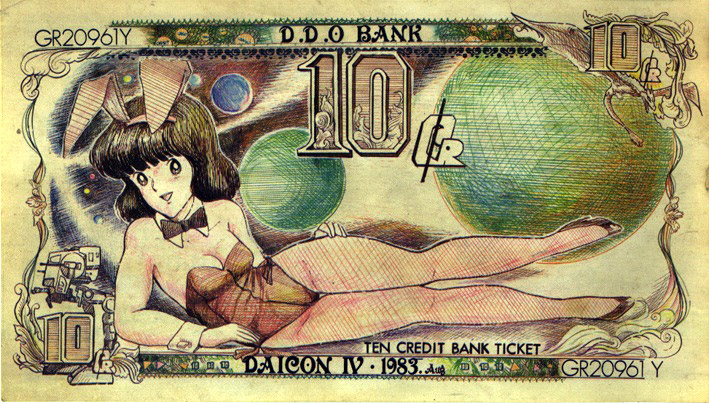
Due to copyright problems an official release of the animations has proven impossible. For the American release of the film, the rights to use of the Playboy bunny costume was denied and the rights to
Electric Light Orchestra's music was consequently not sought.
[6] However, a
laserdisc featuring
Daicon III & IV Opening Animation was unofficially released in Japan as bonus material to a ¥16,000
art book of the animations. This laserdisc is considered rare and highly valuable among collectors, easily fetching prices over a thousand
dollars on online auctions.
[6]
Legacy
Since its release the animations have been referenced several times in Japanese media productions, especially those focused on otaku culture. Clips and characters from the animations appear in the 1991 Gainax OVA
Otaku no Video. The opening sequence of the
Train Man Japanese TV drama series from 2005 was inspired by and uses the Electric Light Orchestra theme and the lead character from the
Daicon IV film.
[7] In episode 5 of Gainax's
FLCL, titled "Brittle Bullet", Haruko flies in on a guitar and attacks a giant robot with her slingshot and yells "Daicon V" in reference to the
Daicon IV.
[8]
At Fanimecon, Yamaga said, "[The openings are] a source of pride and something you want to strangle." Akai who wants to produce better films stated, "I don't want to see them for a long time. Just thinking about them sends shivers down my spine."
[9] Lawrence Eng stated that without the
Daicon animations,
Gainax might never have existed.
[10] In 2001, the anime magazine
Animage ranked the
Daicon animations as the 35th of the "Top 100" anime of all time.
[11]
Notes
- Notes
- a^ : Astron, Jamira, Zarab Seijin, King Joe, Seabonzu, Twin Tail, Gesura, Dada, and Saturn.
- b^ : She races past Gyango, Red King, Baltan Seijin, Takkong, Pole Seijin, Z-Ton, Mephilus Seijin, and Seagoras, tossing them all aside.
- c^ : C-3PO and Chewbacca from Star Wars, Nazoh from Moonlight Mask, and a Pira Seijin with a nametag reading "Tarō the Blaster" (Bakuhatsu Tarō) on his chest are all in the audience.
- d^ : Shown are Captain America, Robin, Batman, Spider-Man, Superman, and Wonder Woman.
- e^ : Such as Thunderbird, a TIE fighter, and the Millennium Falcon. Kamen Rider, Jumborg Ace, the Shooting Star, nurses, an Ohmu from Nausicaä of the Valley of the Wind,Nausicaä herself, Lynne Minmay, Mazinger Z, Kool Seijin, Cutie Honey, and others.
- f^ : Some of the many characters shown in the crowd scene are Anna, Apollo Geist, Ātman, Bandel Seijin, Barom One, Bart, Bat, Big X, Boss Borot, a Brutishdog, Captain Dyce,Char Aznable, Cobra, Cornelius, Cyborg 009, Densen Man, Doruge (a Toei kaijū), Fighters, Doraemon, Gavan, Gill-man, Gort, Hack, Hakaider, Hell Ambassador, the Invisible Man, Inspector Zenigata, Kamen Rider V3, Kanegon, Kemur, King Joe, Lum Invader, Lupin III, Maria from Metropolis, Metalinom, Metaluna Mutant, Martian from the 1953 War of the Worlds, Ming the Merciless, Moonlight Mask, Q-tarō, Pris, Robby the Robot, Robokon, the Robot Gunslinger from Westworld, Robot Santōhei, Snake Plisskin, Soran the Space Boy, Space Ace, Speed Racer, Spock, Superman, Super Sentai, Susumu Kodai, Tetsujin 28, Triton, and a Xilien.[12]
- Bibliography
External links
------------------------
Italian:
[Il daikon (in giapponese daikon 大根, letteralmente "grossa radice", nome scientifico Raphanus sativus var. longipinnatus), chiamato anche ravanello cinese, ravanello giapponese, o ravanello invernale, è una varietà del ravanello comune originaria dell'Asia orientale. L'epilogo del Daicon III chiarirà il perché di questo nome.]
Lo studio d’animazione Gainax ha aperto un sito teaser per celebrare il 33° anniversario del Daicon Film, il gruppo di produzione film independenti che ha formato le radici dello studio.
Nel sito si parla di questo “progetto Daicon Film 33” come “Revival del Daicon Film” con “varie produzioni.” mostra anche la sagoma di un "certo personaggio" (ah,ah,ah!!!) con la data 8 Gennaio 2014.
Il gruppo Daicon Film ha creato due complicati corti di animazione d’apertura del Daicon III e del Daicon IV Nihon SF Taikai, le Conventions Giapponesi della Science Fiction del 1981 e del 1983. Diversi degli artisti che hanno partecipato ai corti, hanno poi creato il nucleo di quello che sarebbe diventato lo studio Gainax.
Source: animeclick.it
Era il 1981, quando Osaka venne scelta per ospitare il ventesimo Nihon SF Taikai, l'annuale festival fantascientifico giapponese. Manifestazione importante per tutti gli appassionati di fantascienza nipponici, e luogo in cui veniva assegnato il prestigioso Premio Seiun per la miglior opera sci-fi dell'anno, ogni sua edizione aveva un “soprannome” basato sulla città ospitante (Tokon se si svolgeva a Tokyo, Daicon ad Osaka, Meicon a Nagoya e cosi via...); quell'anno aveva quindi luogo il Daicon 3, a un decennio di distanza dal precedente. Era consuetudine lasciare l'organizzazione dell'evento ad alcuni studenti universitari del luogo e la scelta ricadde su Toshio Okada e Yasuhiro Takeda, un duo appassionato di fantascienza (compresi anime e tokusatsu, all'epoca abbastanza trascurati nel settore) che aveva già partecipato a conferenze sull'argomento. E fu così che Okada ebbe l'idea di un breve filmato d'animazione come introduzione alla manifestazione; vennero contattati alcuni studenti dell'Università d'arte di Osaka, tali Hideaki Anno, Hiroyuki Yamaga e Takami Akai. In questi studenti molti avranno riconosciuto alcune delle figure più importanti nel panorama dell'animazione giapponese e i fondatori del celeberrimo Studio GAINAX (Gunbuster, Nadia, Evangelion, Gurren Lagann).
Torniamo tuttavia al 1981; questo piccolo e affiatato gruppo di futuri talenti animò un brevevideo di circa 5 minuti da trasmettere durante il festival. L'anime mostra una bambina (dal design palesemente ispirato all'estetica lolicon di Hideo Azuma) che riceve da una coppia di alieni un bicchiere pieno di un misterioso liquido che attirerà sulla bambina l'attenzione di numerosi nemici. Ispirati alle più famose saghe fantascientifiche dell'epoca, a contrapporsi alla nostra piccola protagonista vedremo Godzilla, la corazzata Yamato, l'Atragon, l'Enterprise, il Gundam RX-78 e tanti altri. Dopo aver sconfitto tutti i nemici grazie a una forza sovrumana e un armamentario degno del miglior cyborg, la bambina giungerà in un deserto per versare il liquido donategli su una rapa “daikon”, che si trasformerà in una nave interstellare a forma di rapa gigante, con cui potrà salpare per lo spazio, chiudendo il video e dando inizio al 20° Festival di fantascienza.
L'evidente sforzo profuso e l'ambizione riposta dall'inesperto gruppo di animatori fecero si che il video avesse il successo sperato, tanto che Anno e Yamada furono chiamati l'anno successivo come animatori della prima serie di Macross. Ma non era finita qui: Anno e soci si erano talmente divertiti a lavorare insieme da decidere di fondare la DAICON Film, con cui produrre tokusatsu a basso budget.
Nel 1983, inoltre, il Nihon SF Taikai tornava di nuovo ad Osaka, per il Daicon 4, a soli due anni di distanza dal precedente; alla DAICON film fu nuovamente affidata la cura di uno breve special animatoper introdurre il festival.
Il Daicon IV Opening Animation è, sotto tutti i punti di vista, un'evoluzione del precedente cortometraggio, grazie alla maggiore esperienza dell'originale gruppo, nonché all'aggiunta di alcuni loro amici come Yoshiyuki Sadamoto e Mahiro Maedaed animatori professionisti come Ichiro Itano eNarumi Kakinouchi, conosciuti da Anno durante i lavori su Macross. La protagonista è la stessa bambina di allora, cresciuta e vestita con una sexy divisa da coniglietta (palesemente ispirata alle Play Boy Bunny). Dopo i primi 90 secondi, in cui viene riassunto il precedente cortometraggio, assistiamo ad una nuova serie di combattimenti contro un ampio ventaglio di creature fantascientifiche. La nostra sexy Bunny Girl sfiderà Darth Vader in un duello con le spade laser, prenderà a calci Zaku e demoni, solleverà e farà volare via il robottone deiDynaman, volerà a cavallo della spada Excalibur, viaggerà in altre dimensioni insieme ai supereroi dei comics americani e assisterà alle classiche esplosioni nucleari marchio di fabbrica degli anime sci-fi catastrofisti.
Qualitativamente questo corto risulta decisamente superiore al precedente, con animazioni molto più curate e una delle maggiori hit del momento,Twilight degli Electric Light Orchestra, come colonna sonora, venendo accolto ancora più calorosamente dal pubblico e sancendo definitivamente il successo di questo piccolo gruppo di studenti sconosciuti.
I due Daicon Opening Animation sono, sostanzialmente, fan-service allo stato puro, il sogno della prima generazione otaku, un'irriverente celebrazione della fantascienza, un entropico calderone di citazioni e riferimenti. Il secondo video, addirittura, è col tempo diventato leggendario nell'ambiente degli anime-fan, venendo citato spesso e volentieri in altre opere. L'esempio più eclatante è quello della opening del drama di Densha otoko, che non solo ripercorre piuttosto fedelmente il video originale, ma riutilizza la stessa Twilight come colonna sonora.
Purtroppo questo video non ha mai goduto di un'edizione ufficiale per il mercato home video per problemi di diritti, causati da un uso non autorizzato sia del costume da Bunny Girl rubato a Play Boyche della canzone Twilight utilizzata come colonna sonora.
Tuttavia, sebbene non sia mai stato venduto ufficialmente, è stato possibile distribuirne una copia “abusiva”, allegando il laserdisc DAICON III & IV Opening Animation come bonus all'art-book dedicato alle animazioni dei video.


È probabile che senza questi due brevi video, specialmente il secondo, lo Studio GAINAX non sarebbe mai nato, o comunque sarebbe stato molto diverso da quello che tutti conosciamo. Fu solo grazie alla notorietà acquisita con i due cortometraggi che due anni dopo, nel 1985, la DAICON Film, cambiato nome in Studio GAINAX, riuscì ad attirare l'attenzione di Makoto Yamashina di Bandai, il quale, dopo aver visionato ed apprezzato un loro breve pilot, decise di assegnare loro ingenti capitali per la lavorazione del loro primo lungometraggio, Le ali di Honneamise (Honneamise no tsubasa) che, uscito due anni dopo, sarebbe diventato il film più costoso della storia dell'animazione giapponese (titolo successivamente passato ad Akira, La principessa Mononoke e Steamboy). Nonostante il considerevole spessore narrativo e tecnico dell'opera, Honneamise è ancora oggi tristemente noto come il più grande flop dell'animazione cinematografica nipponica, tanto che, a distanza di vent'anni, nessuno ha ancora avuto il coraggio di finanziarne il seguito. Ma questa, è un'altra storia...