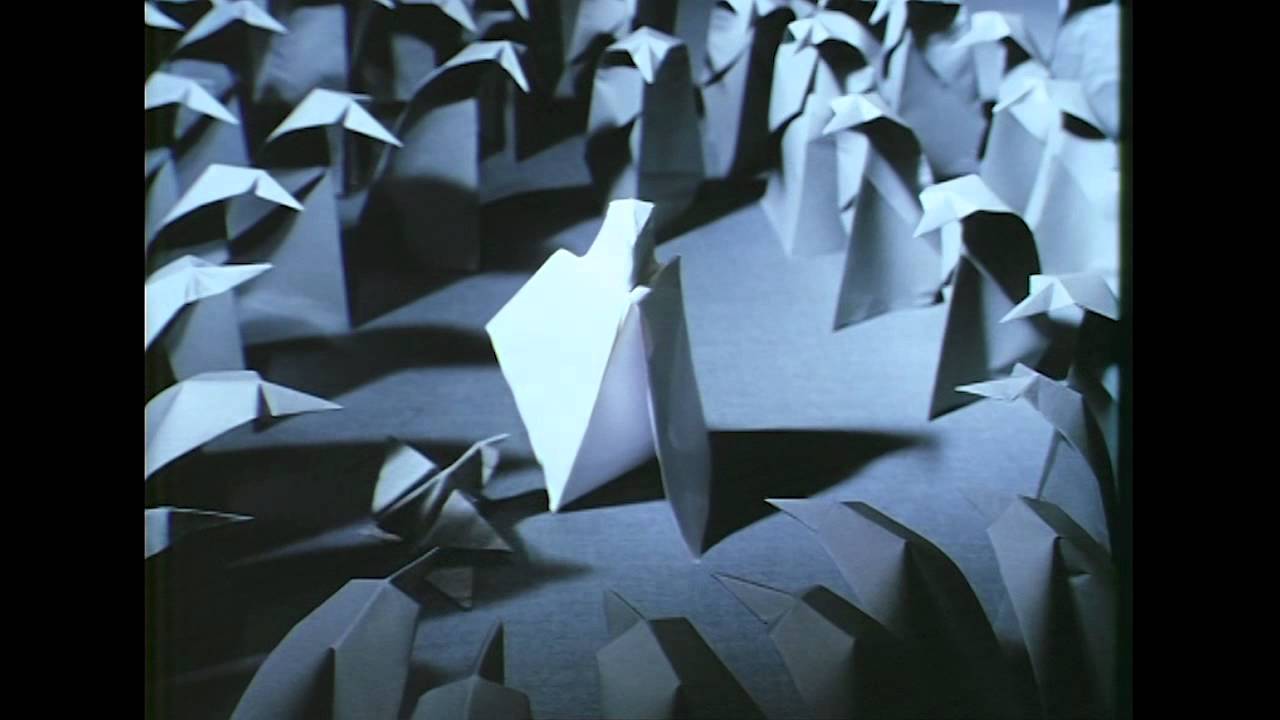
[...] Adagio is legendary animator Garri Bardin‘s 10-minute stop motion masterpiece in origami, set to Remo Giazzotto's Adagio in G minor. The events of this stark fable about ignorant intolerance among shadowy bird-creatures unfold [huhh huhh!] against a minimal backdrop in a variety of expert shots. The famous string score [used in the 1962 adaptation of Kafka's The Trial, and 1998 film Show Me Love just to name a couple] imparts a melancholy tension throughout [...].
[...]Adagio is loosely based on one short stories, Maxim Gorki’s legend of Danko and his burning heart. A part translation, part summary by E.J. Dillon, under the cut [...].
[...] Many thousands of years ago in a land of the sunrise beyond the sea, among a despised people who had been driven by a hostile race to the forests from the fertile steppe, lived the hero of this story, Danko. From the swamps and marshes of this dense virgin forest rose mephitic vapors which decimated the persecuted clan. These miserable fugitives, finding no outlet from their living sepulcher, finally decided in despair to seek out their foes and give themselves up to slavery or death .
At the critical moment the handsome young Danko comes forward and, like David among the Hebrews, boldly offers to save his people from the ruin with which they are threatened, to lead them onward to light and life [...].
FROM: http://coilhouse.net/2009/01/adagio/
Sources:
Tratto da: "Adagio di Garri Bardin", di Sofia Rondelli
[...] il racconto, in Adagio, è pressochè inesistente, o meglio si rivela elemento subalterno al punto nevralgico del messaggio che raggiunge la sua limpidità fin dai primi minuti centrali dell'animazione. Credenti, agnostici, atei e scettici: non sarà la religione o il pensiero d'appartenenza ad alterare la purezza e il vigore lirico che anima ogni singolo fotogramma. Eppure ci chiediamo: dove sta la grandezza di questa breve pellicola? Nel suo messaggio? Nell'utilizzo minimale della scenografia e dei suoi personaggi costruiti ad origami? Oppure nella parabola filosofica che, invano, ridesta le folle ignoranti? Possono essere metodi di osservazione più che giusti e basterebbero certamente a ritenere questo corto una perla da custodire quasi gelosamente. Ma Garri Bardin si spinge oltre: per mezzo di una tecnica fondamentalmente semplice (lo stop-motion), quanto relativamente complessa per i tempi necessari che essa richiede, il cineasta russo trasla il tema della diversità, dell'incomprensione e della paura ad un pensiero di carattere universale. Al di là di tutte le osservazioni in merito, la superiorità di questo corto risiede appunto nella sua “universalità”, nel senso più profondo delle sue valenze simboliche, una crasi mistica tra ciò che è spiegabile, razionalmente compreso, e l'incredulità di fronte al miracolo. La sintesi encomiabile raggiunta da Bardin, rivela allo stesso tempo la sua naturale complessità. Come quando ci accade di leggere un haiku e lo sforzo conseguente di trovare in essa la totalità del mondo, il tutto dentro una goccia come l'1+1=1 che troviamo in Nostalghia di Tarkovskij, oppure la goccia che riflette il Tutto in una scena de Il diamante bianco, un documentario diHerzog del 2004 [...].
About Remo Giazzotto's Adagio ...
Remo Giazotto (September 4, 1910, Rome – August 26, 1998, Pisa) was an Italian musicologist, music critic, and composer, mostly known through his systematic catalogue of the works of Tomaso Albinoni. He wrote biographies of Albinoni and other composers, including Vivaldi, the composer of the Four Seasons.
Giazotto served as a music critic (from 1932) and editor (1945–1949) of the Rivista musicale italiana and was appointed co-editor of the Nuova rivista musicale italiana in 1967. He was a professor of the history of music at the University of Florence (1957–69) and in 1962 was nominated[clarification needed] to the Accademia Nazionale di S. Cecilia.
In 1949 Giazotto became the director of the chamber music programs for RAI (Radio Audizioni Italiane) and in 1966 its director of the international programs organized through the European Broadcasting Union. He was also the president of RAI's auditioning committee and editor of its series of biographies on composers.
Giazotto is famous for his publication of a work called Adagio in G minor, which he claimed to have transcribed from a manuscript fragment of an Albinoni sonata that he had received from the Saxon State Library. He stated that he had arranged the work but not composed it. He subsequently revised this story, claiming it as his own original composition. The fragment has never appeared in public; Giazotto stated that it contained only the bass line, and the work was copyrighted by Giazotto.[1][2]
http://en.wikipedia.org/wiki/Remo_Giazotto
Su "l'Adagio" di Remo Giazzotto ...
Giazotto è famoso soprattutto per il catalogo sistematico delle opere di Tomaso Albinoni e ancora di più, per aver recuperato il celeberrimo Adagio in sol minore.. Quest'ultimo, noto anche come Adagio di Albinoni, è una composizione musicale barocca che sarebbe stata scritta nel XVIII secolo, ma pubblicata soltanto nel 1958 da Remo Giazotto. Il musicologo dichiarò di essersi limitato a "ricostruire" l'Adagio sulla base di una serie di frammenti di Tomaso Albinoni che sarebbero stati ritrovati tra le macerie della biblioteca di Stato di Dresda – l'unica biblioteca a possedere partiture autografe albinoniane – in seguito al bombardamento della città avvenuto durante la Seconda guerra mondiale. I frammenti sarebbero stati parte di un movimento lento di sonata (o di concerto) in sol minore per archi e organo.In verità, a partire dal 1998, anno della morte di Remo Giazotto, l'Adagio si è rivelato una composizione interamente originale di quest'ultimo, giacché nessun frammento o registrazione è stato mai trovato in possesso della Biblioteca Nazionale Sassone.