Sources: wiki/Dororon_Enma-kun, themanime.org, animenewsnetwork.com
Note: "Key Animator, Yoshinori Kanada"
Alternative title:
ドロロンえん魔くん (Japanese)
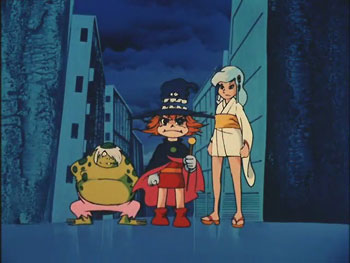
Plot Summary: Emma-kun, Yukiko Hime, and Kapaeru are members of a Demon Patrol that are sent to the human world to arrest demons.
Running time: half hour per episode
Number of episodes: 25
Vintage: 1973-10-04 to 1974-03-28
Opening Theme:
"Dororon Enma-kun" by Chika Nakayama
Ending Theme:
"Be Careful of Ghosts" by Chika Nakayama
Official website:
Dororon Enma-kun Toei Animation Website (Japanese)
Links: We have 1
News:
NISA Anime Industry Panel (Jul 1, 2011)
New Anime in Japan Update (May 7, 2006)
[from: themanime.org]
[...] Go Nagai? Though he's largely known for the very popular anime adaptations of his super robot manga, including such Boomer generation staples as Mazinger Z and Getter Robo, he first gained notoriety with a late Sixties shounen comic called Shameless School. Some of the tropes we often see in ecchi titles originate from that manga, and at the time, it was a breath of fresh air. It was also a satire of Japan's "culture of shame," and to get an idea of how successful it was, the series so infuriated parents and teachers that it started a well-publicized feud between Nagai and the PTA that culminated in Nagai ending the manga with a story arc about the school's all out war... with a parody of the PTA.
Read today, the manga doesn't seem worth the fuss. The nudity is cute, not lascivious, and a sense of mischief makes even the most perverse pranks seem casual and harmless. But at the time, it redefined where the boundaries were for manga, and made room for new stories. Nagai would later go on to draw defining works in other genres, but he always loved wacky, perverse mischief, and used it often in his comics. Shortly after Shameless School's successful run, he wrote another comedy, one that combined perverse satire with the heroism of his super robot comics: Enma-kun. And now, some forty years later, here comes studio Brains Base with an adaptation of Enma-kun. It's not a faithful adaptation- it's clearly an update on the source material that doubles as an homage to Nagai and Japanese children's entertainment in the Seventies. Which sounds dull and insular, but Brains Base goes one step further in flattering the Nagai legacy by imitating not just its battiness, but its edginess. And in 2011, that makes it a libertine comedy that's starkly different and a damned sight funnier and fresher than B Gata H Kei or MM. And perhaps that's the key thing that sets Dororon Enma-kun Meerameera apart from any other anime comedy released in the last few years, ecchi or otherwise: it knows its history.
But I risk putting Enma-kun in a very small box that it doesn't deserve by just talking about its ecchi aspect. It runs the gamut of comedy- Japanese puns that are indecipherable to an English speaking audience, satire, snark, meta-humor, well-timed sarcasm, and the occasional toilet joke all mix together in a roiling melting pot that also includes some romance, action and hot-blooded heroism. The humor isn't particularly sophisticated or clever- it's not so much a sharp sword as a broad hammar, and if one thing doesn't getch ya, something else will- but it works through a combination of creativity, and a good use of escalation. The latter is something Enma-kun is particularly good at: it isn't very funny when a goblin makes a pun on his nose, for example, but when he keeps doing it and doing it in increasingly absurd ways for an entire episode, it gets there. In fact, the entire plot of Enma-kun is a great example of escalation, starting with small-time demons threatening a school and ending with the world's greatest orgasm threatening mankind's existence.
And did I tell you about the demons? The demons are fabulous, their design all inspired by Japan's rich yokai mythology but primarily comedic. The series relies on the classic "Monster of the Week" formula- which it enjoys messing with sometimes- and for that to succeed, you need good villains. Most of the monsters are silly takes on some staples from Japanese mythology, though some of them seem to be entirely the product of Nagai's fertile creative mind. In keeping with the series' spirit of silliness, the demons rely on some pretty silly curses, like a "rolling" demon who makes people so fat that they can only move by rolling like an oversized basketball, or a "slippery" demon who makes our heroes take constant, humiliating pratfalls by cursing their feet to find no friction on the ground [...].
[from: wiki/Dororon_Enma-kun]
Dororon Enma-kun (ドロロンえん魔くん Dororon Enma-kun), also known as Satanikus!, is a Japanese horror-comedy anime and manga series created byGo Nagai. It's one of Nagai's most famous works in Japan, although not very well known in the rest of the world. In 2006, it would get a sequel/remake inDemon Prince Enma, which drops the comedy and becomes a full-fledgedsuspense-horror series. After the OVA was released, another manga version was released called Satanikus ENMA Kerberos by Eiji Toriyama. A remake entitled Dororon Enma-kun MeeraMera began airing in Japan in April 2011.
Plot
Enma, Yukiko-Hime and Kapaeru are part of the Yokai-Patrol. They go after ghosts that have escaped from Hell into the human world.[1]
Characters
- Enma-kun (えん魔くん)
- Voiced by: Masako Nozawa (1973), Kappei Yamaguchi (2011)
- The hot-headed, perverted protagonist, sent by his uncle to arrest yokai that have infiltrated the human world, though most often then not he ends up going overboard and killing them instead. He has long eyebrows that can detect a yokai's presence and wields a powerful cape and a fiery staff which can transform into a massive hammer.
- Yukiko-Hime (雪子姫)
- Voiced by: Sumie Sakai (1973), Mamiko Noto (2011)
- A beautiful ice princess who is in love with Enma, but often has to put up with his pervertedness. She has powerful ice powers, though more often than not gets captured in a fanserviceable manner.
- Kapperu (カパエル Kapaeru)
- Voiced by: Kaneta Kimotsuki (1973), Takehito Koyasu (2011)
- Half kappa, half water sprite. He is the third member of the Yokai Patrol. He doesn't have a lot of attacks, but still provides some help in battle. He's often confused for a frog, which makes him very angry.
- Chapeauji (シャポーじい Shapōjii)
- Voiced by: Junpei Takiguchi (1973), Minoru Inaba (2011)
- An "old man" yokai who looks like a hat and guides Enma-kun. His name is a portmanteau of 'chapeau' and 'ouji' ("old man" in Japanese).
- Tsutomu-kun (ツトムくん)
- Voiced by: Takako Kondo (1973), Rumi Shishido (2011)
- A human boy that befriends the Yokai Patrol. He attends the local elementary school, and always gets attacked by demons. He is a side character in the 2011 anime.
- Tobatiri (トバッチリ Tobacchiri)
- Voiced by: Akira Shimada (1973), Daiki Nakamura (2011)
- Tsutomu's teacher. He's merely a comic relief, and always yelling at Tsutomu-kun.
- Daracura (ダラキュラ Darakyura)
- Voiced by: Takuzou Kamiyama (1973), Hideyuki Umezu (2011)
- A homeless deadbeat, Daracura was originally an officer for Enma-Daiou. After losing his position of officer, Daracura tried throughout the series to kill Enma-kun. However, as the series progressed Daracura became less important.
- Harumi (ハルミ)
- Voiced by: Reiko Katsura (1973), Ayako Kawasumi (2011)
- Tsutomu's girlfriend. Her mother has passed on, and lives with her father in an apartment complex. She replaces Tsutomu as one of the main protagonists in the 2011 anime.
- Great King Enma (閻魔大王 Enma Daiō)
- Voiced by: Hidekatsu Shibata (1973), Norio Wakamoto (2011)
- The Judge of Hell and Enma's uncle. He sends Enma-kun and his friends to arrest demons on Earth.
- Enbi-chan (艶靡ちゃん)
- Voiced by: Rumi Shishido (2011)
- Enma's cousin; the protagonist of the spin-off manga, Dororon Enbi-chan, and an antagonist in the 2011 anime. She has her own versions of Yukiko-Hime and Kappaeru named Yukiko-Hige and Kapaku.
- Anime
- Main articles: List of Dororon Enma-kun episodes and Demon Prince EnmaThe original anime was produced by Toei Animation and was originally broadcast on Fuji TV from October 4, 1973 to March 28, 1974. The opening theme was "Dororon Enma-kun (ドロロンえん魔くん) and the ending theme was "Be Careful of Ghosts (妖怪にご用心 Yōkai ni go Yōjin), both performed by Chinatsu Nakayama. An original video animation of the sequel manga,Demon Prince Enma, was produced by Brain's Base and was released in four volumes released between August 25, 2006 and March 23, 2007. The OVA is licensed in North America by Bandai Entertainment. A remake of the original series, titled Dororon Enma-kun Meeramera (Dororonえん魔くん メ~ラめら), was produced by Brain's Base and aired on MBS between April 7, 2011 and June 24, 2011. The opening theme is "Soul Burning at 1,000,000,000°C!! (魂メラめら一兆℃! Tamashii Meramera Icchō °C!) by Masaaki Endoh and the Moonriders, whilst the ending theme is "Everybody's Exhausted ZZZ" (みんなくたばるサァサァサァ Minna Kutabaru Sasasa) by The Moonriders feat. Yoko.[2]NIS America licensed the series in North America under the title Ghastly Prince Enma Burning Up and released the series on subtitled DVD and Blu-ray Disc on September 11, 2012.[3][4]
Manga
The main version of the manga was originally serialized in Shogakukan's magazine Weekly Shōnen Sunday from September 30, 1973 to March 31, 1974.[5][6][7] - Chief Director: Koro YabukiEpisode Director:Masamune Ochiai (eps 7, 14)Masayuki Akihi (ep 25)Tomoharu Katsumata (eps 19, 24)Original creator: Go NagaiCharacter Design: Takeshi ShiradoArt Director: Toshio FukumotoKey Animation: Yoshinori KanadaProduction manager: Kiyoshi OnoTheme Song Composition: Asei Kobayashi (OP,ED)Theme Song Lyrics: Chika Nakayama (OP,ED)Theme Song Performance: Chika Nakayama (OP,ED)
- Broadcaster: Fuji TVProduction: Toei Animation